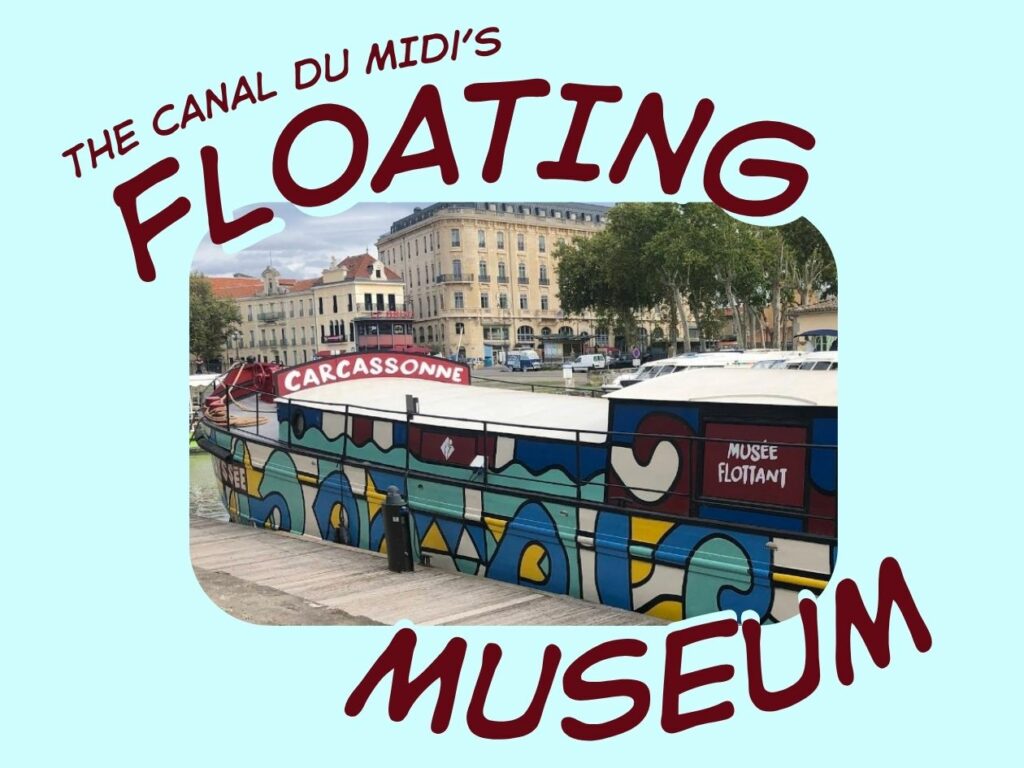
Walk to the Canal lock in Carcassonne, cross the bridge toward the Train Station, and you’ll spot it immediately, a 28-metre barge splashed head to toe in yellow and blue, looking less like a boat and more like something that escaped from a gallery wall in the Musee des Beaux Arts. That’s the Europ’Odyssée, and stepping inside it is one of the more unexpected things you can do in Carcassonne. The experience it houses is called L’Odyssée du Canal. It is defn worth a visit!
First, the boat itself has lived several lives
Before it ever became a museum, this barge had a story most boats can only dream of.
It was built back in 1931 in the Netherlands, and spent its early decades hauling cargo – unglamorous, useful work. Then in 1986 a couple named Francis and Cécile Belot bought it, moored it on the Seine in Paris, and turned it into a home. The Belots were documentary filmmakers, and in 1992 they did something slightly mad: they loaded up the barge with their two one-year-old daughters and set off across Europe. The plan was a six-month trip. It turned into two years and more than 8,000 kilometres, all the way to Russia and back, filmed as a daily series for French television. It still holds the record as the longest river journey ever started from Paris.
That same year, the street artist Speedy Graphito – one of the founding figures of French urban art – repainted the entire hull. That’s when it earned the name “Europ’Odyssée” and became a floating artwork in its own right. Later, in the 2000s, the barge took on yet another role, becoming a home for vulnerable young people working alongside specialist educators.
So by the time Carcassonne’s tourist office bought it in 2024 and turned it into an interactive museum, she had already been a cargo ship, a family home, a documentary star, and a refuge. You can feel that layered history before you even step aboard. The paint job alone is worth a photo, and it doesn’t cost a thing to admire from the towpath across the canal or from just past it on the opposite side looking back towards the city.
What the experience is actually like
Now, fair warning, because this catches some people off guard. L’Odyssée du Canal takes place inside the hull of the boat, in complete darkness, with no windows or view of the outside. You’re sealed in for the duration. If that sounds claustrophobic to you, it’s worth knowing up front – though for most visitors the dark is exactly the point.
Once the lights drop, the walls come alive. Projections, animated graphics, film, sound, and voices swirl around you, you’re more or less inside the story. It runs about 25 minutes, and in that time it walks you through the life of the Canal du Midi: how Pierre-Paul Riquet dreamed it up and got it built in the 17th century, the very real headaches that followed once boats started running (silt kept clogging the canal bed and grinding traffic to a halt), and how Louis XIV eventually sent the military engineer Vauban to sort out the mess. It’s the kind of engineering tale that sounds dry on paper and turns out to be genuinely gripping when it’s projected onto the walls around you in the dark.
Visitors who’ve done it tend to come away pleasantly surprised. People describe it as immersive and educational without being stuffy, praise the friendly staff, and like that you move through it at your own pace rather than being herded around. One small gripe that comes up more than once: the boat is easy to miss if you don’t already know it’s there, so the fact that you’re reading this puts you ahead of the game.
The practical bits
Here’s everything you need to plan it, in one place:
- Where: Port du Canal, 11000 Carcassonne – the barge is moored right by the harbour. GPS coordinates are 43.21757, 2.35013 if you’d rather just follow the dot and here is the google map link https://maps.app.goo.gl/FR78gEnvXxu2tsif6
- Getting there: Honestly, it could not be easier from the train station – you’re talking a two-minute, 175-metre stroll. By bus, hop off at the Carcassonne – Chénier / Gare SNCF stop. It’s also a short walk from the Bastide Saint-Louis, the lively grid-pattern lower town.
- How long: Around 25 minutes for the experience itself.
- Languages: French, English, and Spanish. In high season there are typically five French sessions a day plus one in English and one in Spanish, so check the timetable and grab the slot in your language. This is the link to book it in ENGLISH https://reservation.tourisme-carcassonne.fr/the-canal-odyssey.html
- Age guidance: Recommended for ages 14 and up, and under-18s need to be accompanied by an adult. The age advice is really about the enclosed, pitch-dark setting rather than anything in the content. There is space for 12 attending each time.
- Booking: Reserve online ahead of time – it’s strongly recommended, and walk-up spots aren’t guaranteed. After you book, give it about 15 minutes for the confirmation email to land. For June there is only one English slot each day 17:00 and July and August there are two 13:00 and 18:00
- Turn up early: Plan to be there at least 10 minutes before your session. Latecomers can be turned away, and tickets are non-refundable and non-exchangeable, so don’t cut it fine. Your confirmation will tell you exactly where to gather – usually right by the barge or at the tourist cabin point beside it.
And here’s the sweetener for 2026: the Canal du Midi is marking 30 years since it joined the UNESCO World Heritage list (it was inscribed in 1996), and to celebrate, the Europ’Odyssée experience is FREE this year. You’d be a little foolish to skip a free, beautifully produced bit of history sitting two minutes from your train.
Where it fits in a Carcassonne day
Think of this as the perfect bookend to a visit. If you’re arriving or leaving by train, it slots in with zero detour – do it while you’re waiting, or as a gentle wind-down after a sweaty afternoon clambering around the medieval ramparts. It also pairs naturally with a wander along the canal towpath and through the Bastide Saint-Louis, the part of Carcassonne where locals actually live, eat, and shop.
The Cité will always be the headline act, and rightly so. But the painted barge by the water gives you something the fortress can’t: a quiet, surprising, slightly offbeat half-hour that ties the whole region’s story together – and reminds you that Carcassonne is a real, layered place, not just a castle on a postcard. Give it your time. You won’t regret it.