If you’ve spent any time walking the streets of Carcassonne, you’ve probably noticed the word Cathar everywhere – on wine labels, museum signs, tourist brochures, the names of hiking trails. It’s hard to miss. But who actually were the Cathars, what happened to them, and why does this corner of southern France still feel so defined by their story eight centuries later? Here’s the short version.
Who Were the Cathars?
The Cathars were a religious movement that flourished across the Languedoc – the region of southern France that includes Carcassonne – during the 12th and early 13th centuries. They called themselves simply Christians; their neighbours distinguished them as “good Christians.” It was the Catholic Church that labelled them Albigenses, or Cathars.
At its core, Catharism was a dualistic, Gnostic movement centred on the belief in two gods – one good, one evil. The material world, in their view, was the creation of a malevolent force; the spiritual world was where goodness resided. The goal of life was to free the soul from the trap of the physical. It sounds abstract, but the practical implications were striking: Cathar priests lived simply, had no possessions, imposed no taxes or penalties, and regarded men and women as equals – aspects of the faith which appealed to many at the time who were disillusioned with the Church.
In the Languedoc, known for its high culture, tolerance, and liberalism, Catharism was virtually the state religion. All the noble families of the area were either known Cathars themselves or active sympathisers. This wasn’t a fringe movement hiding in the hills – it was mainstream life in this part of France.
The Catholic Church was not pleased.
The Crusade: 1209
What followed was one of the most brutal episodes in medieval European history. During the Albigensian Crusade of 1209-1229, the Roman Catholic Church, with the support of the French monarchy, launched a persecution of the Cathars in which it is estimated up to 500,000 people were killed – including not just Cathars but many civilians suspected of sympathising with them.
The crusade was led by the English knight Simon de Montfort, and it arrived at Carcassonne in the summer of 1209. The two outer settlements around the citadel fell quickly and were burned, while the fortress itself resisted the attacks well. In the end it was drought and thirst that forced the Viscount of Carcassonne to capitulate after two weeks of siege.
What happened next was a particular kind of medieval betrayal. On 14 August 1209, the Viscount Raymond-Roger and nine of his subordinates were given safe conduct to negotiate terms – but then, in breach of that safe conduct, Raymond-Roger was seized and thrown into prison, where he died in mysterious circumstances. The city’s inhabitants were expelled, famously allowed to leave carrying nothing but their sins. Simon de Montfort took the city for himself.
It was a turning point. The Cathars retreated to the rocky fortresses scattered across the hills south of Carcassonne, where the crusaders pursued them for another two decades. By 1244, a final renewed push ended the last serious Cathar resistance at Montségur, where around 220 people were burned alive. Voltaire, writing centuries later, called it one of the most unjust wars in history.
What’s Left to See
The remarkable thing about Cathar history is how physically present it still is. The landscape of the Aude is dotted with ruined castles that tell the story of the crusade in stone.
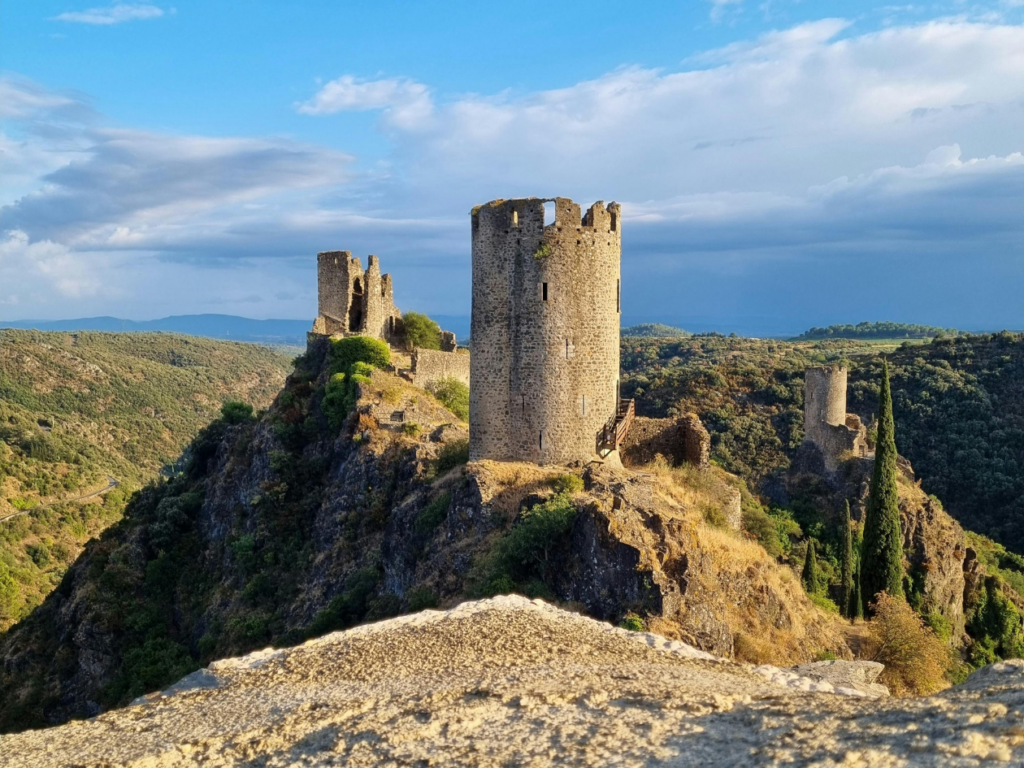
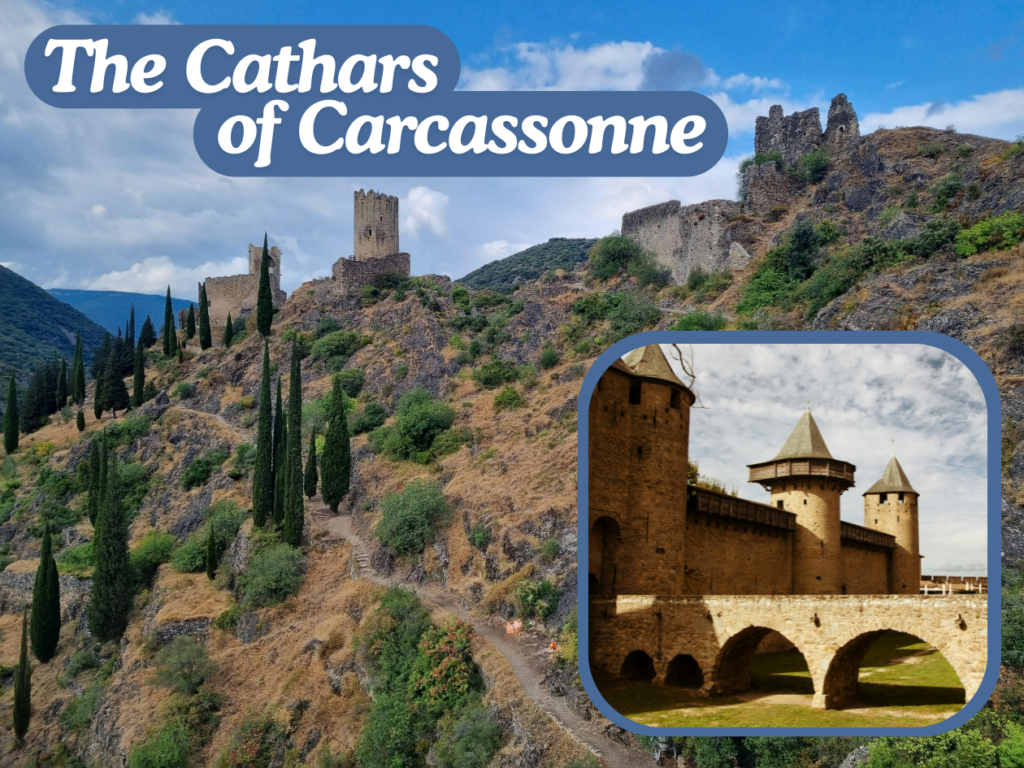
The Châteaux de Lastours, just 15 km north of Carcassonne, is a tight group of four defensive structures clustered on rocky ridges of the Cabardès hills. Built in the 11th century during the peak of the Cathar period, Lastours was an important centre of Cathar resistance and today offers spectacular panoramic views. It’s the easiest day trip from the city, and genuinely dramatic.
Château de Termes, about an hour’s drive southeast of Carcassonne, was one of the first major castles to fall during the crusade, resisting siege for several months in 1210 in one of the longest standoffs of the entire campaign. The ruins sit in a stunning natural landscape and are popular with hikers.
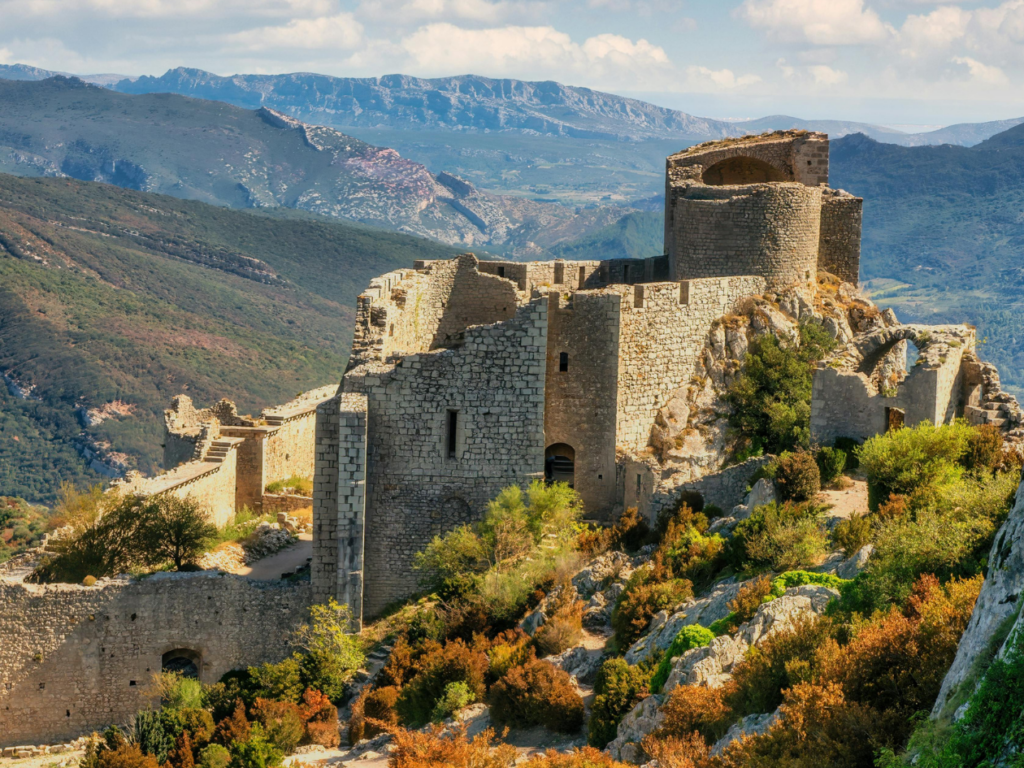
Château de Peyrepertuse, further south towards the Spanish border, is sometimes called the “celestial Carcassonne” – a vertiginous citadel overlooking the Corbières massif that seems to touch the sky. It’s one of the most visited Cathar castles in the region, and its dramatic condition and location explain why.
And then there’s Montségur, about 90 minutes south of Carcassonne in the foothills of the Pyrenees – the most emotionally charged of all the sites, and the place where Cathar history effectively ended. The climb to the ruined fortress is steep, but the views and the weight of what happened there make it unlike anywhere else in France.
Back in Carcassonne itself, the Château Comtal – the fortified seat of power of the Cathar Trencavel family – was at the heart of the 1209 siege, and visiting it today is the most direct way to connect with the history without leaving the city. The guided tours inside the ramparts cover the siege in detail, and the Basilique Saint-Nazaire next door, with its Gothic stained glass, is where much of the medieval drama of the city played out.
One More Thing
If the history hooks you and you want to go deeper, Kate Mosse’s novel Labyrinth weaves together modern and medieval storylines set in the Languedoc with the Cathars at its centre. It’s an easy, gripping read and enormously popular in this region – you’ll spot it in every bookshop in Carcassonne. Not bad prep for a walk around the ramparts.